
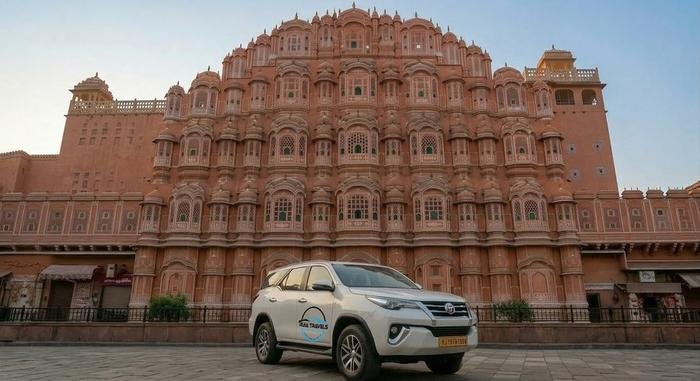
The Golden Triangle — Delhi, Agra, and Jaipur — is the classic first introduction to India for most international visitors, and for good reason. In roughly a week you can see the seat of Mughal power in Delhi, stand in front of the Taj Mahal at sunrise, and wander the pink-walled lanes of Jaipur's old city. Doing it by private chauffeur-driven car, rather than trains or a rigid group tour, gives you the flexibility to linger where you want and skip what doesn't interest you — and covers roughly 720km of driving across the full loop, all on well-established highway routes connecting India's three most-visited cities.
Route Overview: Distances and Road Conditions
The classic Golden Triangle loop runs Delhi to Agra, Agra to Jaipur, and Jaipur back to Delhi — or in reverse, depending on your entry point. All three legs run on well-maintained National Highways and expressways, among the best-conditioned road corridors in India, since they carry the country's heaviest international tourist traffic.
| Leg | Distance | Drive Time |
|---|---|---|
| Delhi to Agra | ~230 km | 3.5-4 hrs |
| Agra to Jaipur | ~240 km | 4-5 hrs |
| Jaipur to Delhi | ~280 km | 5-6 hrs |
The Delhi-Agra leg runs primarily on the Yamuna Expressway, a modern six-lane expressway that's genuinely fast and smooth — this is often the quickest and most comfortable stretch of the entire loop. The Agra-Jaipur and Jaipur-Delhi legs use a mix of national highway and state highway, generally in good condition with occasional slower stretches near town centres, similar to most inter-city routes across Rajasthan.
A Realistic 6-7 Day Itinerary
Delhi (2 days) — Old Delhi's Jama Masjid and Chandni Chowk, Humayun's Tomb, India Gate, and the Lotus Temple. Delhi's traffic is genuinely intense compared to Agra or Jaipur, so a driver who knows the city well saves real time navigating between sights.
Delhi to Agra (Day 3) — Around 230km, roughly 3.5-4 hours by expressway. Most travelers arrive by late morning and spend the afternoon at the Taj Mahal and Agra Fort. A sunrise visit to the Taj the next morning, before the crowds and heat build up, is worth building into the schedule — it's a noticeably different, quieter experience than a midday visit.
Agra to Jaipur (Day 4) — About 240km, 4-5 hours. Many itineraries stop at Fatehpur Sikri en route, the abandoned Mughal capital, which adds roughly an hour but is a genuinely worthwhile detour rather than a filler stop — the scale and preservation of the site surprises most first-time visitors.
Jaipur (2-3 days) — Amber Fort, City Palace, Hawa Mahal, and the old city's bazaars for block-printed textiles and jewellery. Jaipur rewards a slower pace more than Delhi or Agra do; it's worth resisting the urge to rush through it in a single day.
Where to Stop Along the Way
Beyond the three headline cities, a few stops genuinely enhance the trip without adding meaningful detour time. Fatehpur Sikri, mentioned above, sits almost directly on the Agra-Jaipur route and adds only about an hour. Sikandra, on the outskirts of Agra, holds Akbar's Tomb and is a peaceful, far-less-crowded alternative or addition to the Taj Mahal visit if you have a spare hour. Between Jaipur and Delhi, Neemrana is a popular stop for travelers wanting a heritage hotel lunch or overnight stay roughly midway, breaking up what's otherwise the longest single driving leg of the loop.
Why a Private Car Over Trains or Group Tours
Trains between these cities are workable but require fixed schedules and separate local transport arranged at each stop once you arrive. Group tours move at someone else's pace, with fixed stops and limited flexibility if a particular site interests you more than the group's schedule allows. A chauffeur-driven car means you set your own timing, add or skip stops as you go, and travel door to door without hauling luggage through stations or coordinating with a tour group's collective schedule. Every Ruia Travels chauffeur speaks functional English and is used to guiding first-time visitors through unfamiliar cities, which matters considerably in a place like Old Delhi where navigation without local knowledge can eat up real time.
What It Costs
For a 6-7 day Golden Triangle circuit, a comfortable sedan or SUV with driver typically works out considerably less per day than booking separate local taxis at each city, once you factor in convenience and no re-negotiating fares at every stop. As a general reference, per-kilometre outstation rates with Ruia Travels range from around ₹11/km for a Maruti Dzire sedan up to ₹50/km for a Toyota Fortuner, with the Innova Crysta and Toyota Hycross available in between for larger groups wanting more comfort on the longer legs. Exact pricing depends on vehicle choice, exact itinerary, and number of days — get in touch for a quote tailored to your dates.
Best Time to Go
October through March offers comfortable daytime temperatures for sightseeing across all three cities, and is when the vast majority of international visitors travel this route. April through June gets very hot, particularly in Agra and Jaipur where midday temperatures regularly exceed 40°C, and is worth avoiding unless necessary. Monsoon season, July through September, brings occasional heavy rain that can affect road conditions on the Agra-Jaipur and Jaipur-Delhi legs, though the Yamuna Expressway to Agra generally holds up well year-round.
Extending Beyond the Classic Triangle
Many travelers with more time extend the loop to include Ranthambore National Park for a tiger safari (roughly 3-4 hours from Jaipur), or continue on to Udaipur or Jodhpur for a broader Rajasthan circuit rather than looping straight back to Delhi. If you're already committing a week or more to the trip, it's worth discussing these extensions at the planning stage rather than as an afterthought, since routing and vehicle choice can be optimized for the full itinerary rather than just the core three-city loop.
What a Typical Day Looks Like
On a driving day, your chauffeur will typically plan for an early start to avoid both traffic and midday heat, with a fuel stop and a proper meal break built into longer legs like Jaipur to Delhi. On city days — where you're based in one location for sightseeing — the vehicle and driver are simply on call throughout the day, moving between monuments and markets on your schedule rather than a fixed sightseeing bus timetable. This flexibility is one of the more understated benefits of the private car model: if you want an extra hour at Amber Fort or decide to skip a planned stop entirely, there's no group to coordinate with.
Tolls, Fuel Stops, and Practical Driving Notes
The Delhi-Agra Yamuna Expressway and the highway legs to and from Jaipur all carry toll charges, typically billed separately on actuals rather than folded into a flat quote — this is standard practice and any transparent operator will explain it clearly at booking. FASTag covers virtually all toll plazas on this route now, so cash isn't usually needed at the barriers themselves. Fuel and rest stops are well-established along all three legs, particularly the Yamuna Expressway, which has modern service plazas roughly every 40-50km with clean restrooms and food options — a genuine improvement over older highway infrastructure elsewhere in the country.
Departure timing matters more on the Jaipur-Delhi leg than the others, since it's the longest single stretch. Leaving by 7-8am comfortably avoids both Jaipur's morning traffic and arrival into Delhi during its notorious evening rush hour, which can add a genuine hour or more to the journey if timed poorly.
Choosing the Right Vehicle for the Loop
For a couple or solo traveler, a Maruti Dzire sedan is efficient and comfortable across all three legs, and easier to manoeuvre through Old Delhi's narrower lanes near Chandni Chowk. Families or small groups typically prefer the Toyota Rumion or Innova Crysta for the additional space, particularly useful given the amount of luggage most Golden Triangle travelers carry across a week-plus trip. For larger groups of six or more, or anyone prioritising extra comfort on the longer Jaipur-Delhi stretch, the Toyota Fortuner or a Force Urbania van are worth considering — the added ride comfort is noticeably more valuable on a 5-6 hour drive than on shorter city transfers.
Booking a Fixed Driver for the Full Loop
One advantage of arranging the entire Golden Triangle circuit through a single operator is continuity — the same driver typically stays with you for the full loop rather than being swapped at each city, which matters more than it might initially seem. By the Agra-Jaipur leg, a driver who's been with you since Delhi already understands your pace, your preferences for stops, and any specific requests, rather than starting from scratch with someone new at each city boundary. It also simplifies logistics considerably: one booking, one fixed price for the full trip, and one point of contact throughout rather than coordinating separate local transport at each stop.
Managing Crowds at the Big Three Sites
The Taj Mahal, Amber Fort, and Delhi's Red Fort are all genuinely busy during peak season, and timing your visit within the day matters as much as timing your trip within the year. The Taj Mahal is least crowded at sunrise opening (it opens roughly 30 minutes before sunrise year-round), and again in the final hour before closing — midday sees the heaviest tour bus traffic. Amber Fort in Jaipur follows a similar pattern; an early arrival, ideally before 9am, means exploring the fort's courtyards without competing for photo spots at every turn. Delhi's Red Fort and Jama Masjid are typically busiest on Fridays and public holidays, so a weekday visit if your schedule allows it makes for a noticeably calmer experience.
A private chauffeur-driven itinerary makes this kind of early-start planning genuinely practical in a way a fixed-schedule group tour often doesn't — if the plan calls for a 5:30am departure to catch the Taj at sunrise, that's simply what happens, without waiting on a group's collective readiness.
Frequently Asked Questions
How many days do you need for the Golden Triangle?
A realistic itinerary runs 6-7 days, allowing 2 days in Delhi, 1-2 in Agra, and 2-3 in Jaipur, with driving days built in between. It's possible to compress this to 5 days, but it feels rushed, particularly in Jaipur.
Is it better to start the loop in Delhi or Jaipur?
Either direction works equally well distance-wise. Most international travelers start in Delhi since it's the primary international gateway, then continue to Agra and Jaipur before flying out or continuing their trip from Jaipur.
Is a private car more expensive than a group tour?
Not necessarily, once you factor in flexibility and no separate local transport needed at each stop. Pricing depends on vehicle choice and trip length, but a private car often works out comparable to or less than a mid-range group tour package.
Can I extend the trip to include Ranthambore or Udaipur?
Yes — many travelers extend the classic loop to include a Ranthambore tiger safari or continue on to Udaipur or Jodhpur. It's best discussed at the planning stage so routing and vehicle choice suit the full itinerary.
Book Your Golden Triangle Trip
Ruia Travels has been running chauffeur-driven trips across Rajasthan for over 30 years, since 1996. Explore our outstation tour options or book a car directly for a custom itinerary.